
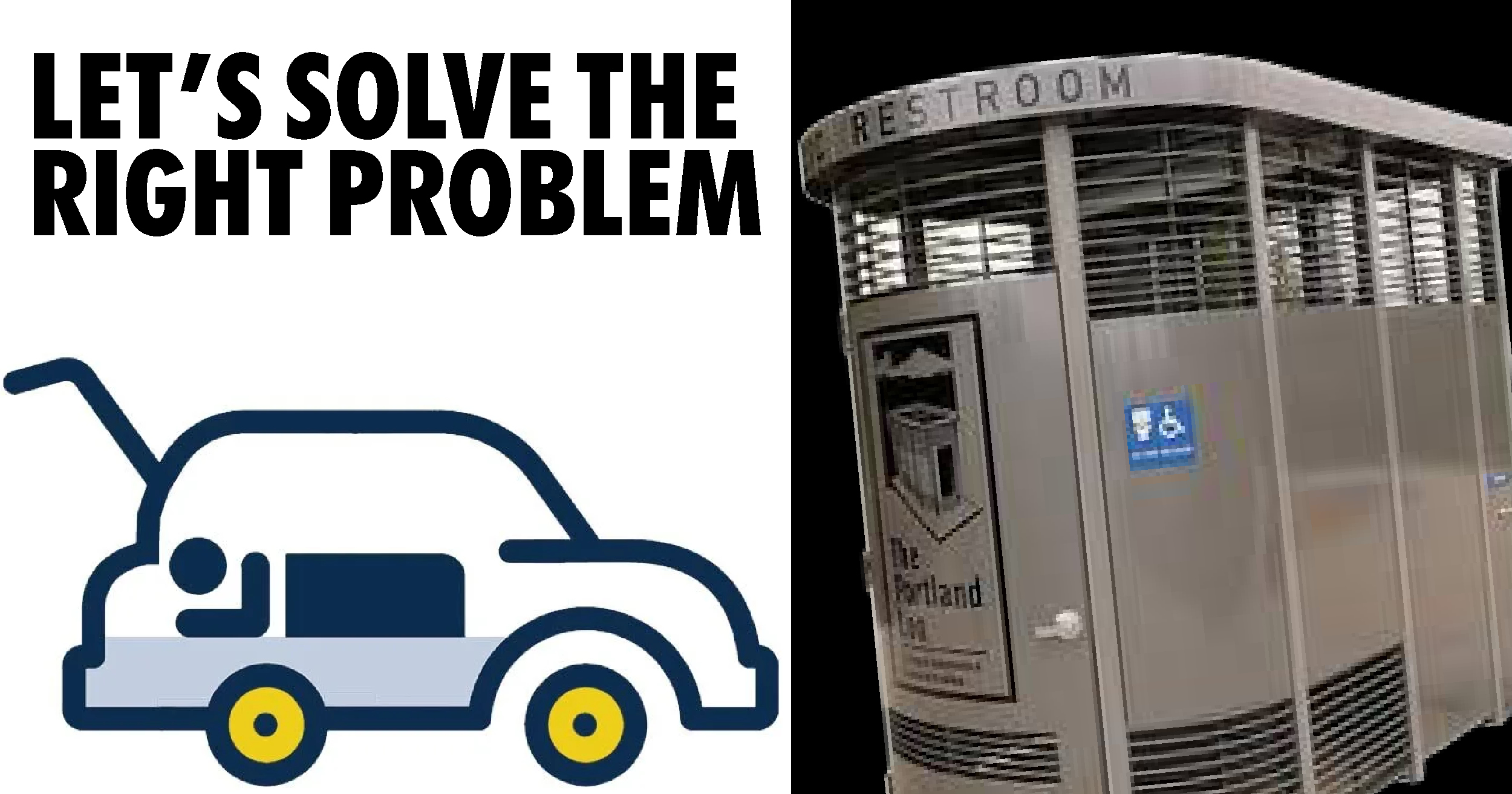
Dayton found $334K for two stainless-steel, blue-lit public toilets downtown. Called “Portland Loos” they are a disgusting waste of money.
They look like something out of a sci-fi movie. They don’t solve much. They even lock themselves from midnight to 7am
You can see the powerpoint presentation rationalizing these overpriced shiters here:
You can have some cold hard privacy to do your business in an oval metal box that’s open at the top and bottom, and then go right back to sleeping under a bridge, in a doorway, or in the front seat of a Chevy in a Walmart parking lot hoping security doesn’t knock at 2 a.m.
Meanwhile, we have:
- People sleeping under overpasses, where we dump uneven boulders so they can’t camp.
- People living in their cars, getting shuffled from truck stops to big-box lots to side streets.
- Shelters that are full, or feel unsafe, or have rules that some folks simply cannot comply with.
- Zero places where it’s legal, safe, and sane to park a car overnight and just sleep without fear.
For the holidays, we don’t need another tree lighting, marketing campaign about peace or a free dinner at the convention center that we can all feel good about. We need to get honest: people are already sleeping in their cars here. The choice is whether we criminalize them or organize around them.
Other cities have already done the obvious, humane thing. They built safe parking lots with toilets, some with showers, and basic security. We could copy them tomorrow.
What other cities are already doing
Indianapolis: Safe Park Indy
In Indianapolis, Safe Park Indy partnered with churches and other organizations that have empty lots at night. People living in their vehicles can register, park overnight, and connect to services instead of playing cat-and-mouse with police and tow trucks.
It’s not housing. Even the folks who run it call it “a Band-Aid on a bullet wound.” But as they point out, when someone is bleeding, you still put on the Band-Aid.
The program has had to pause to stabilize funding, which is its own indictment of our priorities. But the model exists, it works, and people there are fighting to bring it back.
San Diego: safe parking as part of a system
San Diego runs a Safe Parking Program operated by Jewish Family Service. They designate lots where people in cars and RVs can park legally overnight. The sites include restrooms, basic needs assistance, access to mental-health and job-training services, and case managers who work with each person on a housing plan.
They’re now adding a new safe parking site at a former elementary school in City Heights, focused on families with kids in the local school district, so children aren’t ripped away from their teachers and friends just because their parents lost a lease.
Santa Barbara and the West Coast pioneers
Wikipedia has a listing of a bunch of safe park programs:
Santa Barbara’s New Beginnings has run a Safe Parking program since 2004. They manage over 200 spaces in 27 lots across the region, mostly behind churches and businesses. People can park, sleep, and access help, instead of being chased from block to block.
Los Angeles scaled up safe parking through the homeless services authority: 12 lots, 130 spots, with portable toilets, food, and social workers at an estimated cost of about $35 per space per night. San Diego’s approach, with fewer security requirements, has been estimated closer to $10 per car per night.
Greensboro, North Carolina, opened the state’s first safe parking site behind a day-service center that already offered showers, laundry, and caseworkers—parking at night, services by day.
Eugene, Oregon’s Overnight and Safe Parking Programs provide legal camping and parking, garbage disposal, and portable restrooms for adults living in vehicles, linked to nearby service centers.
There’s actually a group working on this nationwide. “The National Vehicle Residency Coalition (“NVRC”) is a network of vehicle residents, social service providers, and legal experts joining together to support people living in their vehicles. Our goal is to honor and value the voices of vehicle residents, support their policy and service goals, and protect their legal rights. We believe that a key component of this work is to raise positive public awareness about people living in vehicles and vehicle residency.”
So to answer the number one question small minded people in Dayton always ask about any idea, “has this been done anywhere else before” and there’s plenty of examples in the last few years, dozens of safe parking lots have opened across the country, especially in California, as cities finally acknowledge vehicular homelessness and stop pretending tickets, harassment and towing are “policy.”
What these places have in common
The details vary, but the basic blueprint is simple:
- Designated, legal overnight parking (often 7 p.m.–7 a.m.) so people can sleep without fear of tickets, towing, or harassment.
- Basic sanitation: at minimum, portable toilets and hand-washing stations; many programs also provide showers and laundry access nearby.
- Trash and maintenance: dumpsters and regular cleanup so the lots don’t become the very mess that makes neighbors panic.
- Light and security: some use private security; others rely on staff presence and clear rules instead of turning everything into a police operation.
- Screening and rules: registration, simple code of conduct, quiet hours, no open flames or obvious criminal activity. Not perfect, but far more orderly than unsanctioned parking.
- Connection to services: outreach workers and case managers on-site or nearby, so safe parking is a doorway to housing, not a cul-de-sac. See the San Diego JFS site for more info. Some even provide free wifi.
This isn’t rocket science. It’s recognizing that people living in their cars are often working, parenting, or just barely hanging on. They need stability, not citations. Cars are often all they have left.
Need a guidebook? The University of Washington put a pdf together with all the details.
What Dayton could do — right now
Instead of congratulating ourselves on blue-lit stainless steel toilets downtown, here’s what a Dayton Safe Parking Pilot could look like:
1. Start with one or two lots
We don’t need to solve homelessness in one shot. We need a dignified alternative to “move along.”
- A downtown or near-downtown city-owned lot (close to transit and services).
- A partner lot behind a church or nonprofit that already works with people in crisis.
Capacity: 25–40 vehicles total to start. Prioritize families, seniors, and people who are already working in the region.
2. Provide the basics, not a luxury resort
For each lot:
- 24/7 lighting and clear signage.
- Portable toilets and hand-washing stations year-round.
- A dumpster and regular trash pickup.
- Simple power access (for phone charging, maybe a small warming space).
- A basic check-in system and posted rules.
If we’re feeling ambitious, bring in:
- A mobile shower unit once or twice a week.
- A rotating presence from local clinics, mental-health providers, legal aid, and housing navigators.
All of this costs less about the price we paid for those stainless-steel toilets once you stack up the capital, installation, and maintenance on those monuments to our misplaced priorities.
If Los Angeles can provide basic services and social workers at around $35 per space per night, and San Diego can do a leaner version for about $10 per car per night, then a 30-space pilot in Dayton is not a budget-killer.
At $30 per space per night (a generous estimate), 30 spaces for a full year comes out under $330,000. That’s roughly the cost of the two designer toilets.
3. Staff it like we mean it
- One overnight staff member per lot (could be security with de-escalation training, or outreach workers with backup).
- A part-time case manager shared between sites.
- Coordination with police and fire so they know this is a sanctioned site, not an encampment to clear.
We’re already paying police, courts, jails, and ERs to repeatedly deal with the consequences of having no plan. This is about redirecting money from punishment to basic management.
4. Partner with people who are already doing the work
Dayton has:
- Churches with empty parking lots after 6 p.m.
- Nonprofits dealing with housing, addiction, re-entry, and mental health every day.
- Hospitals and health systems that see the fallout of street homelessness.
- Businesses that say they want to help but don’t know how.
Safe parking gives all of them something tangible to plug into:
- Churches offer lots under a city-backed umbrella (liability covered, clear rules, shared playbook).
- Nonprofits provide outreach and case management.
- Hospitals and health foundations help fund the pilot as a public-health measure.
- Businesses sponsor spaces, provide blankets, fuel cards, or vehicle repairs.
A holiday project that’s actually worth a damn
Every December, we put up lights, run canned-good drives, and hold feel-good events “for the homeless.” Then January hits, the lights come down, and people are still trying to sleep upright in their cars, hiding from security in the corner of a parking lot.
If we really wanted to show we’re a community that cares, our holiday project this year would be:
- City Commission passing a resolution to launch a Safe Parking Pilot in 2026.
- Identifying and announcing the first lot (or two) before the weather gets worse.
- Pulling together a public-private coalition to fund and run it for at least two years.
- Publishing clear metrics: how many people use it, how many move into more stable housing, how many police calls we don’t have to make because we finally gave people a place to be.
We found the political will and the money to drop over a third of a million on two stainless-steel downtown toilets that don’t keep anyone warm, safe, or stable.
Imagine what would happen if we spent the next third of a million on people, not stainless steel plumbing.
This holiday season, if Dayton wants to do something that matters, we could stop pretending vehicular homelessness is a nuisance to sweep away and start treating it as a reality to manage humanely.
A safe place to park and sleep shouldn’t be a radical idea. It should be the baseline.
This is personal to me. I went to a funeral for a friend this year who I found living in his car, sleeping in the South Park Tavern parking lot about 20 years ago. He moved in with a friend for a few years before moving to the Dayton Towers; He used to work at DATV. He is missed. Another friend, was sleeping in his Suburban, while gainfully employed. Another friend, a RN, had a bit of a mental break- and was surfing my couch for about a year. This can happen to anyone, not just the mentally ill or addicts.
End the waste & fraud there will be plenty of money….