
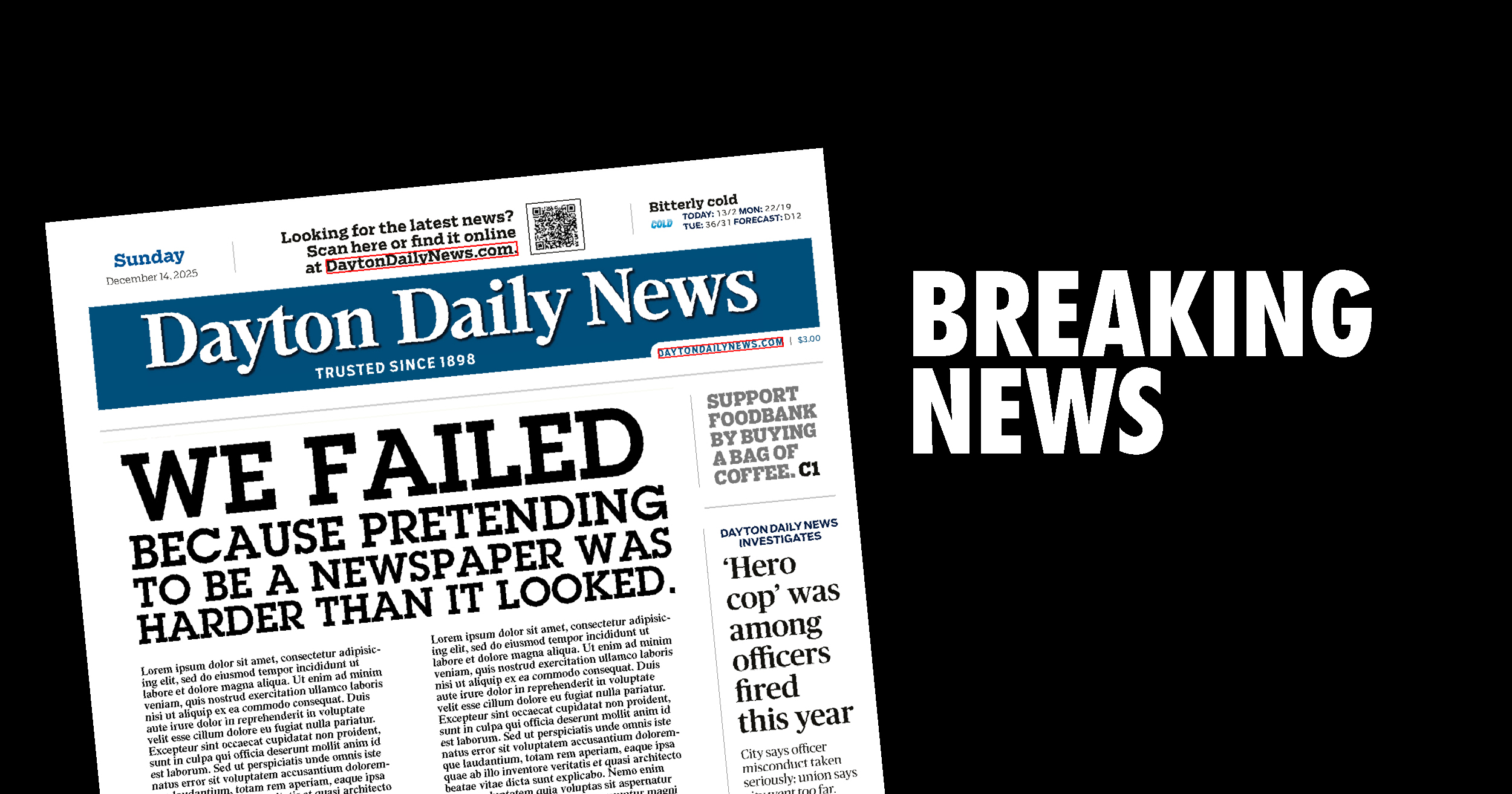
Most people in Dayton do not yet know that the Dayton Daily News has quietly eliminated its Community Impact Editor. They will know eventually, but for now the only public announcement came from a Facebook post by the position’s occupant, Nick Hrkman, who posted on Facebook, that his job ends January 2. For the first time in modern memory, the paper will have no opinion editor.
That he posted on Facebook before the paper announced isn’t just ironic, it’s a fundamental part of the problem.
The loss is not simply another staff reduction. It is the paper stepping away from what a newspaper is supposed to do for a community.
The Daily News has not been truly “daily” for years. The press deadline is around 2 p.m. because the paper is printed out of state, reportedly in Chattanooga. Every subscriber knows the feeling of reading a “newspaper” full of stories they saw online days earlier. Increasingly, the print edition is filled with New York Times articles I read 3 or 4 days before they appear in Dayton.
But eliminating the person whose job was to build local civic conversation and keep the opinion page tied to this actual community signals something much deeper than financial strain. It signals that the institution no longer understands its role.
Why the “Community Editor” position matters
Community editors, opinion editors, and editorial boards exist because democracy requires structure. Someone has to curate local voices, moderate disagreements, ensure accuracy, and maintain an institutional memory of what the community has debated, what it cares about, and what it cannot afford to forget.
Thomas Jefferson understood this when he wrote to Colonel Edward Carrington on January 16, 1787:
“Newspapers without a government” would be preferable to the alternative.“The basis of our governments being the opinion of the people, the very first object should be to keep that right; and were it left to me to decide whether we should have a government without newspapers, or newspapers without a government, I should not hesitate a moment to prefer the latter. But I should mean that every man should receive those papers & be capable of reading them”
James Madison framed the beginnings of the Freedom of Information act in a letter to William T. Barry on August 4, 1822
“A popular Government, without popular information, or the means of acquiring it, is but a Prologue to a Farce or a Tragedy; or, perhaps, both. Knowledge will forever govern ignorance: And a people who mean to be their own Governors, must arm themselves with the power which knowledge gives.” “A popular government without popular information or the means of acquiring it is but a prologue to a farce or a tragedy.”
When a paper cuts the people responsible for preserving civic knowledge, it is not pruning. It is amputating.
The paper’s response is more syndicated content
In the same week when they eliminated the opinion editor, the DDN published two self-congratulatory columns about how important community voices are. One column offered instructions on submitting letters to the editor, which they run mostly on Saturdays, the one day they do not even print a newspaper, and then only two or three letters from the same predictable voices.
The other column boasted about a more “balanced” slate of national opinion columnists. More from the New York Times. More from syndicated right-wing voices. More from national names who know nothing about Dayton. None of this fills the void left by the lack of local analysis, local criticism, or local stewardship.Something that’s been missing since Trump first got elected and they worked so hard to scrub “liberal bias” from the newspaper, confusing bias with the pursuit of facts and open debate.
They did not mention that the newsroom is nearly empty. They did not mention that most of the names readers still recognize left long ago and return only as freelancers. Only one remains a true standout: Tom Archdeacon, who still writes with heart and skill, though mostly through a sports lens. Meredith Moss and Ray Marcano still appear, but let us be honest, they were never pillars the pillars of investigative journalism. The institutional memory of the newspaper has been depleted to the point of embarrassment.
Local journalism is supposed to be a watchdog
Dayton cannot afford this collapse. Not in a county where we have:
• A sheriff who runs a jail with a long history of violence, including the brutal beating of Khalid Mustafa.
• A prosecutor’s office that plays games with technology, plea deals, and sealed dockets (the whole Foley mess). Dozens upon dozens of local jurisdictions, mayors, police chiefs, townships, villages, authorities, districts, and boards, each with taxing power and almost no scrutiny.
• Hundreds of millions in economic development slush spending, handed out like corporate charity disguised as growth.
Just today, the DDN ran a story quoting House Speaker Matt Huffman complaining about Ohio’s “fragmented government.” He is correct about the fragmentation, even if he completely misses the cause-and-effect that makes him part of the problem.
Ohio has 6,500 taxing authorities and 608 school districts. Montgomery County alone looks like a municipal jigsaw puzzle made by drunken cartographers. Fragmentation spreads authority across too many actors to monitor, too many opportunities for waste, too many blind corners for corruption. Need proof, just look to the shit-show that it is New Lebanon right now.
This is exactly why newspapers matter. Fragmented government requires more watchdogs, not fewer. Dayton barely has one left.
Instead of covering the problem with depth, the paper quotes politicians like Huffman as if they are diagnosing someone else’s disease. The truth is that fragmentation multiplies the number of places a watchdog must watch, and the Dayton Daily News no longer has the staff or the capacity to do it. Cutting the opinion editor only compounds the failure.
Esrati.com: filling the void since 2006
Since 2006, I have written more than 3,000 posts on Esrati.com (this is 3,337 to be exact). I have done the work that used to be handled by an entire newsroom: investigations, public records requests, court monitoring, documenting misconduct, and exposing corruption. I have done it with no staff, no ad revenue, and no institutional support. This community reads my work because someone has to do what newspapers once did automatically I’ve filed lawsuits, I’ve questioned the system. I’ve even been arrested for protesting illegal secret meetings of the Dayton City Commission way back in 1996.
Back in 2013, I wrote an April Fool’s post “Esrati.com to shut down, Esrati to work for Dayton Daily News” claiming the Daily News had hired me to run an investigative desk. The joke was funny because it was impossible, but there could be truth to it in an alternative unvierse.. The DDN has never wanted a watchdog with teeth. They do not even want to print my name when they use stories I broke for their reporting. The Khalid Mustafa story, for instance, never made it to print with attribution. Too inconvenient.
The problem is not just incompetence. It is ownership that has no vision.
The future of the paper is digital, but they will not admit it
The very first thing the paper should do is stop printing entirely. It is a financial boat anchor, a logistical nightmare, and a 20th-century vanity. Nicholas Negroponte wrote in 1996 that the future of media was “bits, not atoms.” It would literally be cheaper for Cox to hand every subscriber a Kindle than to keep converting digital content into dead trees trucked up from Chattanooga
A real strategy would include:
• A modern digital platform like WordPress, which the New York Times embraced while Cox clung to proprietary systems that Ray Marcano pretended to understand.
• Verified local comment systems to keep conversation on their own site, not surrendered to Facebook’s digital sharecropping plantation. Build a real community online.
• Investment in local reporting on courts, schools, development, police, and government.
• A real editorial board capable of speaking truth to local power.
• Data-driven ad strategies now commonplace everywhere except Cox Ohio.
• Capitalize and monetize the treasure trove of the archives (morgue in newspaper speak)
But none of that will happen. The owners do not understand the business they are in. They may not even understand the public obligation they inherited.
Newspapers should be community first. A public utility.
It is a public utility of democracy. Ida B. Wells said:
“The people must know before they can act, and there is no educator to compare with the press,”
Walter Lippmann said it with a bit more nuance:
The press is no substitute for institutions. It is like the beam of a searchlight that moves restlessly about, bringing one episode and then another out of darkness into vision. Men cannot do the work of the world by this light alone. They cannot govern society by episodes, incidents, and eruptions. It is only when they work by a steady light of their own, that the press, when it is turned upon them, reveals a situation intelligible enough for a popular decision.
Right now that searchlight in Dayton is fading. Not because the bulb burned out, but because the owner keeps removing pieces of the lamp.
Where do we go from here?
Nick Hrkman’s departure is not about one job. It marks the moment when the Dayton Daily News effectively stopped pretending that local voices matter. The opinion page will continue in name only, filled with syndicated content from people who have never set foot in West Dayton, never watched a commission meeting, never opened an Ohio public records file, never studied a Montgomery County budget
I will continue to do what I have done for nearly two decades. Not because it is easy or profitable, but because this community deserves someone paying attention.
Dayton deserves a newspaper that acts like a newspaper. Until then, I will keep shining whatever light I can into the corners they abandoned.
The truth we need to admit: local journalism must become a public utility
At some point, we need to stop pretending that the market will fix any of this. It will not. Classifieds are gone. Retail advertising is gone. Obituaries and legal notices are the only financial IV keeping the Dayton Daily News technically alive. And as long as journalism is treated as a business first and a civic duty second, the business model will keep shrinking while the civic damage grows.
Local journalism needs to be publicly funded.
Not as a handout.
Not as charity.
As infrastructure.
We fund clean water because the public needs clean water.
We fund libraries because the public needs access to knowledge.
We fund elections because the public needs legitimate government.
Journalism does work just as essential. It monitors power. It documents injustice. It informs voters. It exposes corruption. It keeps institutions honest or at least nervous.
People talk about nonprofit newsrooms as if they are the solution, but most nonprofit journalism is held together with duct tape and pledge drives. WYSO tries hard, but even they fall into the same trap. When I ran for Congress, they did not interview me. They interviewed a hack Dayton Daily reporter covering the race. That is the charity model in a nutshell. Limited resources. Limited reporting. Limited impact.
Most listeners do not pay into the system, and the newsroom lives or dies by grants, foundations, and whatever fundraising guilt can extract. That is not a stable model for a democracy that actually needs investigative reporting.
What Dayton needs is a publicly funded journalism utility. Imagine a county-wide or regional authority with guaranteed funding and legally protected editorial independence. Imagine reporters assigned to every school board, township, commission, and court. Imagine a structured, searchable public record of government actions. Imagine someone whose full-time job is to follow the money in economic development deals. Imagine a newsroom that cannot be bought, shaped, or silenced by advertisers, corporations, politicians, or hedge funds.
That is not radical. It is responsible.
We already fund public defenders to challenge the state.
We already fund judges to rule against the state (sometimes).
We already fund Inspectors General to investigate the state (sometimes).
Journalism deserves the same structural independence with the same stable funding.
If we do not build this, the alternative is worse. We will need to create a new government office whose sole purpose is independent oversight because the private press will be gone. And if we reach that point, we will have waited too long.
Ida B. Wells said the people must know before they can act. Right now, in Montgomery County and across Ohio, the people cannot know because no one is paid to gather the information. And as the Dayton Daily news removes the last pieces of its civic mission, the gap between what the public needs and what the press provides grows wider.
A community cannot govern itself in the dark. At some point, Dayton needs to decide whether journalism is an essential service or a nostalgic relic.
I know what I believe.
And I will keep proving it with every story I write.
SONG: The Day the News Died, by David Esrati
“BREAKING: David Esrati still pretending he owns an advertising agency, when all he’s ever produced has been business cards.” – I love when you criticize DDN like they don’t eat your lunch every day, while for 25 years you’ve never broken half a million in revenue and your biggest web traffic day was you publishing Karin Wicks cause of death. It’s truly peak and you are absolutely fucking pathetic.
David, thanks for this thoughtful and comprehensive assessment of the state of affairs in local print media in Dayton and elsewhere. I’m sorry to learn of yet another fine journalist turned out into the media cold by the Dayton Daily News (owned by Cox First Media). Fortunately, good talent is rarely wasted and I hope Nick Hrkman lands on his feet soon.
This departure (and others) is a sad testament to the state of print media today. The rank and file of Cox First Media’s Dayton Daily News staff are underpaid, overworked, and undervalued. Yet middle and upper management levels remain bloated all the while bloviating on corporate mandates from private, wealthy Cox family owners in Atlanta, Georgia.
The business side has infiltrated the journalism side and subsumed it. The name of the game for Cox First Media is marketing advertisements on its digital platform. “…Cox First Media offers advertisers access to 1.5 million monthly exclusive local digital content visitors, a highly engaged print subscriber base and best-in-class targeted digital marketing services across display, social media, search, video, audio and print to reach any audience your business needs to grow.”
https://www.daytondailynews.com/local/cox-first-media-names-new-sales-leadership/YGCHVRU7KFFSBFW5HNY2TGNOOY/
At least print subscribers are deemed “highly engaged”. Nothing is local anymore, not even the current publisher of the Dayton Daily News, Rob Rohr, who lives in another city/county. The only local listening being done is when it spies and listens to your private conversations.
https://www.techtimes.com/articles/307372/20240904/cox-media-group-reveals-active-listening-software-spies-user-convos.htm
It’s quite obvious why Cox First Media / Dayton Daily News made the opinion pages and the Community Impact Editor spots go dark. It’s been a never ending gutting of editorial writing and opinion. This move is a load of crap, right along with the useless crap commentary from appropriately named “anonymous f*ckwad”.
I decided I was going to post here on this topic after taking a break.. Newspapers are dying.. What you need to do David is expand your reach and be a social media influencer. Create an X account, get lots of followers, a lot won’t be from the Dayton area, and then you have a platform you want for change.
I buy 4-8 newspapers a year. During the 2 weeks of the Olympics I buy newspapers..I used to buy the DDN regularly until 2017-2018 or so. I get my news from X, from intel accounts on X for world wide news. I found out about Rob Reiner from X..You don’t need to scoop the dying DDN. You need to provide your followers with news.. not necessarily your blog.. news.. break a story.. put it on X.. get responses.. your followers will depend on you and you can get monetized on X. I don’t know how many followers you have here on your blog but I’m sure you can get 10’s of thousands of followers on X and provide stories, not just local to Dayton but anywhere in the world. Only thing is X leans Republican..It’s still a large source of news.. Elon Musk owns X, so keep that in mind..
Just a suggestion. I used to be a newspaper guy, but the world has changed, newspapers aren’t a breaking source of news.. They used to be. Facebook, X and Instagram are the new media. I may have mentioned this before but I get most to all of my news from online and that includes X.. Just trying to help! I majored in Mass Communication at Wright State!
…au contraire Hebert Morris. David Esrati has long established himself as a media influencer. Every two years he influences people, thru his rants, to vote for Mike Turner…
My Fellow Americans ! Dayton Daily is propaganda for the Globalist & Deep State, cares nothing about Truth or residents !
Be sure to watch the news tonight !
Time to take out the deep state. Gotta get rid of Moderno and his cartel de Sol. He lost the election and didn’t leave now we bomb the shit out of the deep state assets in Venezuela.
Time to expose the Democrats in RINO’s for being part of the deep state…. You all figure it out sooner or later. But man, I thought you would be a little quicker to be honest.
I don’t know if Wright State has a journalism department but if they do and The Guardian still exists, you should be the first person all journalism majors should contact. There’s no reason why a college paper can’t investigate what’s going on around them. Same thing goes for U.D. If both schools started reporting and having their stories stolen and reprinted by the DDN, it would be a mixed blessing, but at least news would be published.
…yes, jonathan b, the Wright State Guardian still exists, though they have not published a dead-tree edition since 2017. On line with a podcast, the entity has launched a web magazine. Located in the Student Union, the Guardian office is much smaller than the room that the Old Bandito parked his carcass for three years.
Your suggestion that David Esrati “should be the first person journalism majors should contact” displays a lack of understanding of journalism. May I recommend the first person the prospective writer should contact would be the Guardian editor. She alone decides what is of pertinence to WSU readers. This rather than a failed politco with an axe to grind.
Were the Guardian under the stewardship of the Old Bandito, his first act upon hiring would be to hand each writer a picture of David Esrati with the instructions to call campus police is approached…
Well, Tim, the Nation watched our Grifter-in-Chief. Yep, he’s still a LOSER p*ssy a$$ b*tch.
https://apnews.com/video/fact-checking-president-trumps-address-to-the-nation-6932c316e3b44ad18387e111acb88c2b
As to upcoming changes proposed for the Dayton Daily News opinion pages, I reserve judgment. Media’s idea to pit left versus right opinions and little else is not helpful and fosters polarity. Why doesn’t the DDN get rid of most syndicated columnists and use more local voices and letters to the editor? I suspect DDN readers would prefer seeing local voices in the local paper.
Regarding the caustic commentary on the state of false equivalency in media these days, a wise man recently stated this gem: Every opinion is equally valid be it freedom or tyranny.
The media is the only industry granted rights/protections in the US Constitution. Every form of journalism should be protected, championed, and used to its utmost capacity. Further, every US citizen should educate themselves so they choose the best in class to lead our nation. Otherwise, we get the government we deserve like the circus we have now.
David, don’t worry about haters. Take some advice from Jim Carrey & Sundae Gurl LOL.
https://bsky.app/profile/sundaedivine.lol/post/3ma3v56hwvc25
Two questions on local matters:
1) Is US House Rep Mike Turner (OH-10) a “completely broken and beaten man” as some in social and television media have reported?
https://bsky.app/profile/ronfilipkowski.bsky.social/post/3mb3q35smi22n
2) Does the local public actually realize the printed Dayton Daily News is on life support and those in leadership are deciding what day to actually pull the plug?
https://apnews.com/article/media-newspapers-fading-warren-buffett-6cebea1d8b67ab14d062c803cbe0ff42
https://apnews.com/article/atlanta-georgia-newspaper-digital-media-5e9e270e8fdf8d4a7213ec666f401e22