
I have a half a dozen clients who run very different types of businesses over the Dayton well field. All have different rules and regulations about what they can and can’t have in their buildings. None of them have any desire to pollute the well field- or our drinking water- that wouldn’t benefit them, or our community, but the insanity of the actual laws should make everyone in this community stop and wonder what geniuses put this monstrosity into effect.
To bring people up to speed, who may not know what our “well field protection ordinances” are- or why we have them, let’s go back in time. About one hundred years ago- when Dayton was an industrial powerhouse. Back then, there were machine shops and manufacturing plants all over our city. There was even a small machine shop in the alley behind my house when I first moved to South Park. It went up in a crazy hot blaze of fire about 20 years ago- and the building was only recently demolished.
Back in those days, companies big and small had no clue what to do with waste oil, cleaning fluids and the like. Some burned it in open pits, others poured it in the ground, others put it in drums and stored it- only to have the drums leak. It wasn’t until the seventies with the charter of the EPA by the federal government, that everyone got hip to the fact that trichloroethylene, a common industrial solvent was a serious carcinogenic toxin.
Our Dayton well field pumps water out of a giant underground limestone aquifer- said to be one of the largest in the world. And, for a long time, companies in town routinely fouled it. Times changed, with the federal and state EPA regulations. Users of hazardous chemicals were required to maintain extensive logs of their industrial inputs and outputs. Material Data Safety Sheets had to be kept on hand, as did emergency procedures for a spill. The days of wild and wooly hazardous waste disposal were long over by the time the Sherwin Williams paint warehouse burned to the ground on May 27, 1987.
That fire burned for days, with firefighters standing by, trying to contain runoff and not pouring water on the flames- so as not to contaminate the well field. Citizens were terrified that our water supply might get polluted- sales of bottled water skyrocketed and a young Dayton City Commissioner, Mark Henry, introduced his original “Well field protection” ordinance.
If that piece of legislation were still in place, there would be no outcry of the local business owners, but over time, changes in the rules have caused it to be onerously restrictive, very capricious in its enforcement. In other words- it’s silly and enforced randomly.
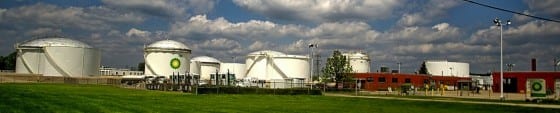
On Brandt Pike there is this little chemical storage facility- right over the aquifer.
One only has to drive out Brandt Pike, just past Stanley Ave., to pass the BP fuel farm where a hundred gazillion gallons of fuel sit smack on top of our well field. A little spillage of the underground pipes would hardly be noticed- and would easily contaminate our water supply. They are allowed to be there- they just can’t add capacity under the current laws.
In the meantime- my baker friend, has a limit of 6 gallons of bleach in his facility. Bringing in the seventh bottle of Clorox would put him in violation. Another friend, who has a machine shop- has reached his limit of cutting oil with his current number of CNC machines, he can’t add a machine, without breaking the law. Never mind the fact that modern day CNC machines are practically hermetically sealed systems that totally prevent leaks- compared to the old school open lathes that were as common as street lights in our manufacturing heyday.
Regulations that are in place now set limits on chemicals based on a base line of when the laws were written. An analogy would be restricting the houses on your block based on the occupants of each home on a random day 20 years ago. If you had 3 kids and grandma and grandpa were visiting- you could have 3 kids and 4 adults in that house, while the house next door- would have been permanently banned from occupancy because your neighbors were on vacation.
The recent situation in Toledo with the algae bloom contamination of Lake Erie is no different than what’s been going on for years in Celina with Grand Lake/Lake St. Marys which is a cesspool of industrial agriculture runoff. This is an entirely different problem- much akin to the old school pouring of toxic chemicals down the drain or into the ground- because companies are too cheap or don’t care about the implications. Sustainable agriculture methods can eliminate almost all of this toxic runoff- but, big ag is more powerful than the people who have to live with their needless pursuit of cheaper crops- even if the side effects are heinous.
If Dayton was serious about protecting our wellfield- there would be no fuel farm sitting over our water supply. But, that would cost hundreds of millions to relocate.
Common sense needs to come to our regulations- with good working relationships between regulators and the regulated, to cooperatively protect our water and our community. For all the “experts” claiming that any changes to the ordinance would put us in greater danger- the reality is, every one of us who has ever cleaned out a paint brush has done more to pollute our well field than many of these regulated businesses. It’s time for some collaboration to come up with a modern, enforceable, realistic set of rules, processes and procedures, and not keep these convoluted rules on the books, because one day, the baker may want to have 7 gallons of bleach to clean and sanitize his bakery, and we wouldn’t want him to be raided by the water protection police.
David:
Nice informative artical David, my question being that if we have lead water pipes leading off of the streets into our houses, wouldn’t that as well be an issue, and one that is not addressed?
David,
I am a big fan of your blog and think that you are more informed than most of the other media outlets in the area. I put you and WYSO on the same pedestal for decent reporting. For this issue, however, you needed to do a little bit more research. The Source Water Protection Program was created to reduce the risk to our aquifer, and although it has a number of flaws in its administration, it is worthy of support. Your math seems to be off in that your friend the baker is not capped at 6 gallons of regulated substances; the ordinance (53.30.1.c) clearly states that cleaning agents that “are present in the same form and concentration as a product packaged for use by the general public, and provided the total inventory of such cleaning agents does not exceed 200 gallons or 1,600 pounds at any time” are excluded from the reporting requirements. I too have friends that are business owners in the Protection Area and don’t have problems with this issue. This use of household chemicals is conforming, therefore it does not fall under the Total Daily Maximum Inventory (TMDI). Your friend the baker should do his homework and if he is getting trouble from the Water Department, he should point them to the ordinance.
As well, your example of cleaning paint brushes is erroneous; our waste water goes to the City’s treatment plant where it is chemically and biologically processed and filtered before being discharged further down the Great Miami, south of our well fields. The greater risk is in fact the businesses that are in the 9% of our City that is deemed as the Well Field Protection Area above our aquifer and well fields. It would be childish to argue that business owners want to contaminate our drinking water, but is completely reasonable to assume that accidents happen, even in the most state of the art facilities (Sherwin-Williams was equipped with a number of industry-leading engineering controls, as well as prevention and mitigation systems for accidents. They all failed within the first fifteen minutes of the blaze.) You can learn more about these controls in the FEMA report that compared the Emergency Management response to a similar warehouse fire in Switzerland. SPOILER ALERT: The Swiss sprayed water on the chemical fire and contaminated their aquifer, they should probably stick to making chocolate and watches.)
http://www.usfa.fema.gov/downloads/pdf/publications/tr-009.pdf
As we see events unfold like the Freedom Industries spill on the Elk River in Charleston, WV, the aforementioned issues of algae blooms in Ohio, and California’s ever-increasing issues of supplying their cities with freshwater, the importance of protecting our aquifer has never been more critical; its value is only increasing as the delivery of freshwater is becoming more challenging and costly in many places across the country.
The Water Department, charged by Nan to “promote business flexibility”, is really just putting forth a proposal to make Mike Gearhardt, one of the most vocal critics of the SWPP, shut his mouth and get his lawyers off the city’s back. They are using the guise of the Ohio EPA’s requirement for municipalities to review (not change) their SWPP every five years. In reality, there are few substantive changes other than the shrunken physical boundary (shaky modeling by the Water Department and challenged by a number of Geology faculty at Wright State and OSU) and the streamlined variance process to allow for businesses to increase their TDMI. This process still counters the ultimate goal of the program however, to reduce the risk to our sole-source aquifer, the only reliable water source for over 900,000 people (Don’t forget that Kettering, Vandalia, Riverside, Centerville, etc., buy City of Dayton water).
What the Water Department should be doing is getting better at administering the program, as well as getting creative. The fact that the City is the largest land holder should be used to create a market-driven incentive program to reduce the risk in the Well Field Area. The Water Department oversees the $10 million Well Field Protection Fund that was ineffectively utilized for the Risk-Point Buy-Down program that bought property’s TDMI and placed easements on the properties for future use. This fund could be used to pay for a reverse auction, where the business that can reduce the most amount of chemicals for the lowest dollar figure wins their bid and is offered a relocation deal. The city has so much land they could afford to establish an industrial park on one of our old factory footprints if they deem it important enough (again, $10 million…). Even if you only relocate one manufacturer a year, you are still reducing the risk over time.
As far as the BP terminals and Cargill goes, simply, if there was a spill, they could pay for it. If one of our small scale manufacturers had a spill on the other hand, they would be out of business paying for the mitigation costs.
Another thing worth checking out is the Wright State Public Administration Research Report on the economic impact of the SWPP. They found no significant difference between the areas in and out of the protection area in terms of economic development, which is exactly the excuse that the City is trying to defend its changes under. The link is below.
https://drive.google.com/file/d/0BzNMB09Aayr7ellPOWxOdGlMZEk/view
Thanks,
Andrew