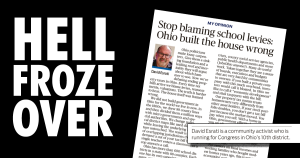
Today my Op-Ed ran in the Dayton Daily News, and they even tagged me correctly as a candidate for Congress in Ohio’s 10th District.Of course, they surrounded it with drivel from Rob Scott about adding income taxes to pay for schools and one of Scott's MAGA lackys, the finance director/tax administrator for the city of Trenton, Matthew Mesisklis. He makes $115K a year [1]. Trenton has 14,660 people, so he only costs the people of Trenton $7.85 ea per year.
The reality is, if I become your congressman, redrawing Ohio’s political jurisdictions maps will not literally be in my job description. It’s a state issue. I wrote that piece because it’s a clean, local example of a much bigger disease: structurally stupid, wildly expensive government that everyone complains about but almost nobody tries to redesign. That includes Trump and agenda of disruption.
Practical things I talk about; building a real voter information system, requiring political donors to be registered just like voters, universal health care, providing payroll software as a government service, fixing the IRS, all come from the same place as that Op-Ed: stop patching a bad system and rebuild it so it works for citizens instead of insiders.
Since the newspaper has a limit on word counts, this is some of the underlying data that supports my arguments. I'll post the full version of what I really wanted to say tomorrow.
The op-ed wasn’t really about levies
If you haven’t read it yet:
“Stop blaming levies; Ohio built the house wrong”
https://www.daytondailynews.com/local/opinion-stop-blaming-levies-ohio-built-the-house-wrong/B42PHBRVWZCVHM5T4YV5SRN77A/ [2]
UPDATE
16 Feb 2026 Or here is the long version and the DDN version without a paywall: https://esrati.com/stop-blaming-levies-ohio-built-the-house-wrong/22147
The core argument:
- Ohio has 611 traditional school districts sitting on top of 88 counties.
- Each one has its own superintendent, treasurer, central office and board before a single dollar reaches a classroom.
- Then we layer 2,200+ townships and municipalities inside those same counties.
- Then we bolt on an alphabet soup of “authorities,” “partnerships,” “coalitions” and “service centers.”
- Then we hammer homeowners with property tax reassessments and tell them “the problem is the levy.”
That’s not a thermostat problem. That’s a blueprint problem.
What the “Big 8” already prove
Ohio already knows how to run large districts efficiently. The Ohio 8 are the big urban systems: Akron, Canton, Cincinnati, Cleveland, Columbus, Dayton, Toledo and Youngstown.
Below are rough numbers for those eight: approximate 2023–24 enrollments (rounded) and superintendent base salaries pulled from public payroll/news. This is good-faith, AI-assisted work; exact figures move slightly year to year, but the orders of magnitude are right.
Ohio 8 – superintendent cost per student (approx.)
| District | Approx. students | Superintendent base | Supt cost per student |
|---|---|---|---|
| Akron Public Schools | 20,000 | $165,000 | $8 |
| Canton City Schools | 8,000 | $189,900 | $24 |
| Cincinnati Public Schools | 34,500 | $270,000 | $8 |
| Cleveland Metropolitan | 34,000 | $285,000 | $8 |
| Columbus City Schools | 47,240 | $274,600 | $6 |
| Dayton Public Schools | 12,565 | $204,750 | $16 |
| Toledo Public Schools | 23,000 | $271,958 | $12 |
| Youngstown City Schools | 4,400 | $160,000 | $36 |
You can argue about exact dollars, but the pattern is obvious: when you spread fixed leadership costs over tens of thousands of kids, superintendent overhead is in the single or low double digits per student.
Now keep that picture in your head and zoom in on Montgomery and Greene counties.
Montgomery + Greene: where the math goes off the rails
Between Montgomery County and Greene County you’ve got roughly:
- 23 traditional districts (not counting ESCs and vocational districts)
- About 85,000–86,000 students total (depending on which year’s data you use)
Again, these are approximate, AI-assisted numbers using the most recent public sources I could find; if you want to litigate whether Beavercreek is at $26.7 or $27.1, you’re missing the forest.
Superintendent overhead Montgomery County districts
| District | Enrollment | Superintendent (recent) | Approx. Supt Salary* | Supt Cost Per Student* |
|---|---|---|---|---|
| Dayton City (Dayton Public) | 12,523 | David Lawrence | $204,750 | $16.35 |
| Kettering City | 7,718 | Mindy McCarty-Stewart | $189,837 | $24.60 |
| Centerville City | 8,075 | Jon Wesney | $166,000 | $20.56 |
| Oakwood City | 1,993 | Neil Gupta | $189,280 | $94.97 |
| Vandalia-Butler City | 2,810 | Robert O’Leary | $200,795 | $71.46 |
| Brookville Local | 1,517 | Jason Wood | $133,640 | $88.09 |
| Mad River Local | 3,719 | Chad Wyen | $153,262 | $41.21 |
| Miamisburg City | 4,829 | Laura Blessing (through 2023) | $152,341 | $31.55 |
| Northmont City | 4,644 | Tony Thomas | $174,000 | $37.47 |
| Valley View Local | 1,722 | Benjamin Richards | $130,000 | $75.49 |
| West Carrollton City | 3,246 | Superintendent (recently Andrea Townsend) | n/a (treasurer at $175k is currently top paid) | n/a |
| Huber Heights City | 5,798 | Jason Enix (leavin) | $160,000 | $27.60 |
| Northridge Local | 1,649 | David Jackson (2023, now Brian Blum) | $157,289 | $95.38 |
| Trotwood-Madison City | 2,448 | Reva Cosby (2023, now Marlon Howard) | $141,804 | $57.93 |
| Jefferson Township Local | 251 | Rusty Clifford (transitioning to Ronda Welch) | $110,000 | $438.25 |
| New Lebanon Local | 1,061 | Greg Williams | n/a (public payroll did not clearly identify sup salary) | n/a |
*Salary and cost per student are based on the most recent public payroll data I could tie directly or very strongly to the superintendent position (usually 2023 or 2024). In a few cases, the very latest contracts may differ slightly, but the order of magnitude is right.
Greene County districts
| District | Enrollment | Superintendent (recent) | Approx. Supt Salary* | Supt Cost Per Student* |
|---|---|---|---|---|
| Beavercreek City | 7,765 | Paul Otten | $215,881 | $27.80 |
| Bellbrook-Sugarcreek Local | 2,583 | Doug Cozad | $151,629 | $58.70 |
| Cedar Cliff Local | 544 | Brian Masser | $140,808 | $258.84 |
| Greeneview Local | 1,232 | Sabrina Woodruff | $135,000 | $109.58 |
| Fairborn City | 4,159 | Gene Lolli (through 2024, now Amy Gayheart) | $182,261 | $43.82 |
| Xenia Community City | 3,657 | Gabriel Lofton | $203,582 | $55.67 |
| Yellow Springs EVSD | 598 | Terri Holden | $146,384 | $244.79 |
Same deal here: a couple of small districts (Cedar Cliff, Yellow Springs) are paying a superintendent the equivalent of $200–$260 per kid per year before a single textbook, bus route or para gets funded.
A few clear takeaways:
- The “big” systems (Dayton, Centerville, Kettering, Beavercreek) are all in the $16–$27 per student range. That’s exactly what you’d expect.
- Mid-sized districts like Xenia are already up in the $50+ per student range for the superintendent alone.
- Then you hit the truly small systems – Jefferson, New Lebanon, Northridge, Brookville – and you get $90–$540 per student just to have someone in the superintendent’s chair.
And remember: this is just one salary line. Add treasurer, assistant superintendents, central-office staff, board costs, legal, IT, HR, etc. Then clone that same structure 23 times in two counties.
To be totally transparent: tracking down every single superintendent’s base pay for all 23 districts is time-consuming and the data are scattered across contracts, local news, and payroll dumps. I used AI tools to search, scrape, and calculate from what’s publicly available. The exact numbers will shift a bit over time, but the pattern is undeniable: the smaller the district, the more insane the per-student overhead.
Now drop Jefferson Township’s latest headlines on top of that:
- New superintendent at $150,000 for about 270 kids. Or a whopping $555.55 per student!
- Simultaneously eliminating high-school busing and cutting K–8 busing within 2 miles to save money.
Pay the superintendent. Cut the buses. Ask for an income-tax levy. Tell voters the problem is “funding.” This is exactly what I meant when I said Ohio built the house wrong.
But, this is all really chump change in the grand scheme of things
One of the only lines in the federal budget that never seems to hit a ceiling is “national defense.” Since Mike Turner first went to Congress, the Pentagon’s budget has gone from about 362 billion dollars in FY 2002 to roughly 910 billion dollars for FY 2024. We can always find an extra half trillion a year for the Pentagon and for the ever-expanding homeland security state. ICE and border enforcement never seem to stand in line like teachers, bus drivers, or nurses.
At the same time, we still pretend we “cannot afford” universal health care, or a serious national child care system, or basic investments in public health that would actually keep Americans alive and working and paying taxes. It starts to look a lot like the way we run schools in Ohio. We keep throwing money at the existing structure, we fight about levies and tests, but we never ask the question “is this the smartest way to build the system in the first place.”
I have said for years that health care is national defense. More Americans are killed every year by lack of care, medical debt and preventable disease than by foreign militaries. Add in the cost of all the untreated mentally ill, who fill our social services and prisons with untreated dysfunction and the savings could be astronomical. The real threat to most families is not a tank brigade. It is a medical bill, a lapse in coverage or a chronic condition they cannot afford to treat. But who am I, compared to a senior member of the Armed Services Committee who has never met a weapons system he did not like.
If you design government to shovel money into defense contractors and private prisons and security theater, you will always “find” money for those things. If you design government to keep people healthy, educated and solvent, you will find money for that instead. The problem is not that America is broke. The problem is that we built the house to serve the wrong priorities and then keep re-electing the same architects.
Now zoom out to the national auctions we call elections
While we’re nickel-and-diming school bus routes, the federal election machine is burning money for fun.
Estimated total spending in the 2024 federal election cycle was around $15.9 billion, the most expensive in U.S. history.
- Roughly half of that came from the top one percent of special-interest donors.
- Billionaire families alone threw in well over $2.5 billion trying to shape the outcome.
And what did we get for it?
- Trump back in the White House.
- A Congress that cannot reliably pass a budget.
- A government that keeps flirting with shutdowns where workers don’t work but still get paid.
In any other job, refusing to do the work but continuing to cash checks is called grounds for termination. In Washington, it’s called “leverage.”
This is not a D vs. R problem. This is a system design and money problem. We have made it almost impossible to elect “clean” candidates who are not bought and sold by billionaires and dark-money networks. And, when you take $16B and divide it by 330M people that's $48.50 for every man woman and child to do something positive- instead of being spent on the political ads we all despise.
Meanwhile, the same people who cheer “disruption” and the “deep state” getting smashed seem fine with:
- Fox News hosts and professional trolls shaping policy.
- A revolving door of ideologues and unqualified cronies running agencies that actually matter (like Health and Human Services).
- A federal government that costs too much, does too little, and explains nothing clearly.
The deep state is not your real problem. The deep waste is.
What I’d bring to D.C. (same logic, bigger stage)
Everything above is the same mindset I’ve been working on with my 501c(4) ReconstructingDayton.org [3]: to build a better wiring diagram, not just the light switch.
If you send me to Congress, here’s how that plays out federally:
1. A real national primary with ranked-choice voting
One single national primary day with ranked-choice voting for president:
- No more endless calendar theater where Iowa and New Hampshire get to be kingmakers.
- No more burning hundreds of millions of dollars on staggered primary campaigns that mostly generate TV ads and donor emails.
- Ranked choice forces candidates to compete for second-choice support instead of just carving the country into hate-based niches.
Fewer elections, less theater, more signal. It directly cuts the cost and absurdity of the way we pick nominees now.
2. A unified voter information + candidate platform (OKDemocracy at scale)
Right now, if you want to know who’s on your ballot, who funds them, and what they actually stand for, you have to hop across ten different sites and still guess.
I want a single, national, publicfully vetted voter information system that:
- Lists every candidate, every race, every donor and every government contract in one open, searchable system.
- Functions as the canonical “campaign site” for every candidate (especially down-ballot), with verified information.
- Lets voters see straight-from-the-horse’s-mouth answers to standardized questions: no consultant fluff, no “I was misquoted,” just their own words, timestamped and archived.
- Works like a dating app for democracy: voters answer issue questions, candidates answer the same set, and the system shows you who actually lines up with you based on policy and record – not yard signs and TV spots.
That’s the national version of what I call OKDemocracy [4]. It cuts the bullshit, not the voter.
3. Donor registration, just like voter registration
If you want to drop serious money into politics, you should have to register just like a voter:
- Verified identity.
- Standardized, searchable public record of who gave what to whom.
- No more hiding behind misspelled names, shell LLCs, or PAC daisy chains.
You could still give. You just wouldn’t get to hide.
4. A free, government-provided payroll system for small businesses
Payroll is literally reporting to the government. We make small businesses pay third-party vendors to do it.
I want a simple, secure, no-gimmick federal payroll platform:
- Free to use for employers under a certain size.
- Automatically keeps up with tax rules, filings, and withholding.
- Plugs into state systems cleanly.
That’s a direct cost cut for small businesses and a way to reduce errors that hammer working people at tax time.
5. Universal health care that actually reduces overhead
We already spend more per capita on health care than any other rich country, and still leave people uninsured or underinsured.
A sane universal system:
- Cuts out duplicated billing and insurance bureaucracy.
- Stops tying health care to employment so people can change jobs or start businesses without risking medical bankruptcy.
- Frees employers from being unpaid benefits administrators.
- Levels the playing field for small employers who can't compete with the scale that large firms can milk the system.
Again, same pattern: consolidate overhead, buy services at scale, be transparent about costs.
6. Fix the IRS from the user outward
The IRS is hated because we’ve allowed the code and the interface to become intentionally incomprehensible:
- Pre-fill returns where the government already has your data.
- Plain-language forms and guidance.
- Focus enforcement on real tax evasion, not the easiest people to audit.
Complexity is a subsidy for the wealthy and well-lawyered. Cleaning that up is structural reform, not just “being nicer.”
7. Stop treating citizens as digital sharecroppers
Right now:
- You create content, provide data, and give platforms your attention.
- They sell ads against it and keep almost all the money.
I want to explore regulatory and technical models where:
- Users have a legally recognized stake in the value created from their data and contributions.
- Platforms have to share a defined slice of that value with the people generating it.
- In other words, if the advertisers want to reach you, you get a cut- not just make the Meta's and Alphabets bottom line fatter.
Again, same logic as my Op-Ed: if you’re paying the cost and creating the value, you should not be the last one to see a benefit.
We spent roughly $15+ billion on the last presidential cycle and still got a government that can’t keep the lights on without drama. We’re running 600+ school districts in Ohio, with places like Jefferson Township paying $550+ per kid just for a superintendent while cutting buses, and then we pretend the problem is “bad voters” or “not enough levies.”
The problem is the way we built the house.
If you want different outcomes, you don’t just need different people. You need people who actually know how to redraw the wiring diagram and are willing to say, out loud, “this is stupid, here’s a better way.”
That’s what that Dayton Daily News Op-Ed was about. That’s what I’ve been doing with ReconstructingDayton.org [5]. And that’s exactly the approach I plan to take to Washington.
If you want to learn about my positions, my campaign, even my opponents in the primary, head over to www.electesrati.com [6] and if you like what you see, consider signing up for my emails [7] or making a donation.
6 Comments To "My op-ed was not about levies. It was about governmental stupidity by design."
#1 Comment By Tim Hart On February 15, 2026 @ 4:44 pm @ 4:44 pm
A lot of that makes good sense David. There should only be one superintendent and school board for the whole county just like Florida does.
That would save tons of money too much duplication then you add the waste fraud and abuse, and the taxpayers literally take it in the teeth. The problem is government doesn’t want smart kids. They would figure out everything’s a damn scam.
I hope the IRS goes by the wayside soon if the tariffs are done correctly like they were up until 1913, they could fund everything.
Look how much money they’ve uncovered in waste fraud and abuse and just Minnesota with transportation ,child food programs, child daycare, and they’ve sent suitcases of cash out of Minneapolis airport back to Somalia and other Third World countries all US taxpayer money. Some estimates once we discover all the fraud and waste it will equal $1 trillion a year that is allowed to happen from the rhinos, Democrats and deep state operatives embedded in our government.
Funny thing is this never came to light until Trump got in office. You’re gonna find out that Trump is exposing all this and he’s gonna be the good guy in the end. Mark my word.
#2 Comment By Donald Phillips On February 15, 2026 @ 11:27 pm @ 11:27 pm
The intent of your screed is irrelevant, Mr Esrati, for hardly anyone ( you often gloat) reads the DDN. The Ohio General Assembly doesn’t give a shit what you ‘think’. As for your outrage over the Pentagon budget, nothing is more costly than a cheap defense. Ask your social welfare state comrades in Europe about the price of cut-rate military establishments. Mike Turner is congressman-for-life as long as he faces opponets such as yourself.
#3 Comment By The Old Bandito On February 16, 2026 @ 5:31 pm @ 5:31 pm
…We spent $16 billion on an election? Hell, we spent that much on Somali Learing Centers in Minnehopeless. But if it got Trump re-elected and kept the Maoists from power, I’d say it’s money well spent…
#4 Comment By Melissa On February 16, 2026 @ 10:51 pm @ 10:51 pm
…Name the Maoist candidate(s) who keeps you up at night, Old Bandito…
…As far as I know, there aren’t any, but you smoke ’em out of your brain, if you can…
…Offer some evidence for $16 billion spent on “Somali Learing Centers”…
#5 Comment By Melissa On February 16, 2026 @ 11:17 pm @ 11:17 pm
Speaking of Minnesota and talking intellectual inconsistency – here’s Minnesota Republican Senator Tom Emmer, an attorney, lobbyist, and politician, who spouts falsehoods with nearly every breath.
He apparently can’t help himself because he is Republican House Speaker Mike Johnson’s political lap dog.
[10]
In Ohio, voter identification is required:
[11]
Provisional ballots can be done if any irregularities are encountered, which can be cured within the time period and with proper identification.
[12]
It’s not a hard process.
Republican Tom Emmer should cease his blowhard ways and stop being a lying shill.
#6 Comment By Melissa On February 17, 2026 @ 11:32 pm @ 11:32 pm
Here’s more governmental stupidity – Republican Mike Rounds (South Dakota).
[13]
What do they feed government types in South Dakota like Kristi Noem & Mike Rounds that makes them so ignorant and tone deaf?
Did US House Rep Mike Rounds never learn about yellow stars, Jews, pogroms, Nazi Germany, concentration camps, World War II, Adolf Hitler, Allies, – anything?
Speaking of yellow stars, the US is building our own public/private concentration camps right here in America to fill up with undesirables. It’s a form of torture for anyone of any color, nationality or ethnicity.
[14]
Ohio Republican DHS spokesperson Patricia (Trish) McLaughlin, herself a short-timer DHS rat soon to jump off the sinking Trump Titanic, cites Republican political chapter and verse to “lock ’em up”.
I expect Trish will join her crooked Republican husband Ben Yoho in Ohio soon for Republican Vivek Ramaswamy’s campaign for governor. Trish and Ben cut their political eye teeth on Ramaswamy’s quest for gold.
[15]
I wonder if Mrs. Ben Yoho will do a fast fade into getting knocked up, never to be heard from again. Trump’s other blonde bimbo liar KKKaroline Leavitt is pregger and will be gone soon to join her “old man”.
Maybe doddering old fool, and half German, Donald Trump has told the young blondes about the Aryan Mother’s Cross Adolf Hitler award given for large families.
Much like the Olympics, a medal was given to women for birthing and raising children in three classes: Bronze (four to five children), Silver (six or seven children) and Gold (eight children or more).
Tick Tock biological clock …