Note: In the rush to get this out- some of my arguments weren't based on the law I cited. This is an updated post 5 Aug 2025
Today, the Second District Court of Appeals dismissed my quo warranto action seeking the removal of convicted Montgomery County Clerk of Courts Mike Foley.
They did it without a hearing.
Without briefing.
Without argument.
And without addressing a single constitutional question raised.
What the Court Held
In plain English, the Court said:
Only government officials may act to remove another government official.
The public has no power to enforce constitutional disqualification if prosecutors refuse.
That is not judicial interpretation.
It is judicial veto of a constitutional safeguard.
What the Constitution Actually Says
The framers anticipated corrupt or cowardly prosecutors. That is why the Constitution includes an independent removal mechanism:
Ohio Constitution, Article II, Section 38
Laws shall be passed providing for the prompt removal from office, upon complaint and hearing, of all officers... for misconduct or other cause provided by law. This method shall be in addition to impeachment.
Two key terms:
- Complaint
- Hearing
I filed a complaint.
The Court refused to allow a hearing.
Nothing in the Constitution says only a prosecutor can file the complaint.
Nothing says prosecutors get veto power over removal.
Yet that is the world this ruling creates.
What the Statute Actually Says
Ohio’s quo warranto statute, R.C. Chapter 2733, requires the action to be in the name of the State. I filed it in the name of the State. That is proper and lawful.
What the statute does not say:
- It does not prohibit citizen initiation.
- It does not contain exclusive filing language.
- It does not grant prosecutors total control.
The Court did not explain how citizens are supposed to secure the “prompt removal” the Constitution requires when prosecutors refuse to act.
Silence is not law.
Silence is abandonment.
Why Their Cited Cases Do Not Apply
The Court cited cases involving people trying to take office for themselves. This case is not that.
- I am not trying to claim the office.
- Foley already holds the office.
- He is convicted and constitutionally disqualified.
- I sought removal only.
There is no case in Ohio where a court has ruled that citizens are powerless if prosecutors refuse to enforce constitutional disqualification.
Until now.
What This Ruling Means
Under the Second District’s logic:
- An official can be convicted.
- Remain in office.
- And if prosecutors refuse to act, citizens have no remedy.
That is not constitutional government.
That is permission-based power.
Political actors protecting other political actors is not oversight.
It is self immunity.
What Comes Next
On Thursday, I will file a Motion for Reconsideration asking the Court to:
- Acknowledge the constitutional right to removal upon complaint and hearing
- Hold a hearing as the Constitution requires
- Clarify that prosecutors do not have exclusive, unreviewable power
- Alternatively, certify the question to the Ohio Supreme Court
This case is bigger than Montgomery County.
If this precedent stands, Ohio citizens no longer have a constitutional remedy when elected officials refuse to enforce the law against themselves.
Public office is not property.
It is not private privilege.
It is public trust.
And trust without enforcement is not democracy. It is monarchy.
Stay tuned. Stay informed. The documents are below so you can read them yourself.
Sunlight exposes power. That is why power fears it.
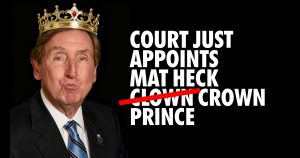
SONG: Crown Prince of No Consequences, by David Esrati, They gave Mat Heck a crown — so I wrote the soundtrack.
8 Comments To "Court Rules Only Politicians Can Police Politicians. That Is Not What Ohio’s Constitution Says."
#1 Comment By Glenda LambWilson On November 4, 2025 @ 4:53 pm @ 4:53 pm
Know you will keep going – any chance someone with another point of view will look at this?
#2 Comment By David Esrati On November 4, 2025 @ 5:17 pm @ 5:17 pm
@Glenda “I will file a Motion for Reconsideration on Thursday, asking the Court to Reconsider” – and then on to the Ohio Supreme Court.
#3 Comment By david jones On November 4, 2025 @ 8:58 pm @ 8:58 pm
Another Esrati loss.
#4 Comment By Jessica O. On November 5, 2025 @ 11:28 am @ 11:28 am
Where in section 2733.04 (Commencing quo warranto) does it say “An action in quo warranto may be brought by a citizen… when the person against whom the action is filed is unlawfully holding a public office.” ? I can’t seem to find that language anywhere in section 2733.
#5 Comment By Donald On November 5, 2025 @ 1:18 pm @ 1:18 pm
Mr Ratty only condemns extra-legal actions because he has never benefited from them. Let there be no doubt, he has his price; only, it is denominated in 1920s Deutschmarks.
#6 Comment By David Esrati On November 5, 2025 @ 2:07 pm @ 2:07 pm
@Jessica O. Thank you. Yes, I screwed up- in the haste to get something up- I relied on ChatGPT for some parts. I appreciate your checking up on me- and I’ve got a new section.
I was so focused on writing the response brief- that this was secondary.
#7 Comment By Dnje On November 5, 2025 @ 4:19 pm @ 4:19 pm
I mean this shouldn’t come as a surprise. The second district court of appeals has a history of some pretty unethical conduct. Including directing threats at attorney for asking for public information. Seems weird that a ton of judges on the court seemed to retire in a short period after 2018. I wonder why that is?
#8 Comment By jonathan b On November 6, 2025 @ 1:48 pm @ 1:48 pm
Your court seems to follow the sheer nonsense of their Superiors.